Tag Archives: Reflections

This is the Tag to identify your two reflection posts that you want to be reviewed and graded.

With a Little Help From A.I. Friend

Over the past several weeks my placement has gained momentum and gone through several stages. Once we had the datasets we needed it, was time to build and train a model to best identify varying types of tree mortality.

Mucho Mortality Dataset

The leaders at Salo created early-stage mortality datasets for large areas of California using LiDAR tree hight in conjuncture with high resolution NAIP and Rapideye spectral data. We decided our next step would be to improve the irregularities and inconsistencies in these datasets and get one, really beautiful, dataset to describe forest mortality in Sierra National Forest. Firstly, I worked to assess the agreement between the NAIP and Rapideye datasets. I found that the NAIP data had higher success in identifying mortality within forested areas on the scale of individual tree crowns, but struggled to identify larger areas of dead trees from old fires or beetle outbreaks. Fortunately, the Rapideye dataset was more successful in these areas (Photos below).


Mortality dataset comparison: Tan = both live, blue = NAIP dead RE live, green = RE dead NAIP live, red = both dead
Continue reading With a Little Help From A.I. Friend

Against the odds

I began this project for Journey North and the UW-Arboretum with high hopes of finding an important correlation between the Ruby-Throated Hummingbird and ecology, seasonality, or phenology. What I found was something altogether different…

Continue reading Against the odds

Reflection 2, part 1: what I’m doing (making maps of solar power generation suitability) and how I’m feeling about it (pretty good)

I’ve spent months on parking lot digitization, weeks on land cover classification, and now I’m finally getting into data visualization. Thankfully, this does not mean I have two weeks to write my report, hold my exit seminar, and make all of the final maps required for the Long Island Solar Roadmap Project. I’m going to continue my work here at The Nature Conservancy through the end of the month of August, during which time I’ll be able to continue to refine data, carry out analysis, and make output maps.

Continue reading Reflection 2, part 1: what I’m doing (making maps of solar power generation suitability) and how I’m feeling about it (pretty good)

Harvest time

Beginning with its initial proposal back in January of 2018, my conservation farming research project has been a long, sometimes challenging, process. But it truly has been an incredible learning opportunity every step of the way. With the survey responses all in and the majority of the analytical work complete, it feels like my hard work is finally bearing fruit. It feels like harvest time.

Continue reading Harvest time

GEE, HOW AM I ALMOST DONE?

Since the last post, I’ve made great progress on my Google Earth Engine script and aim to complete my main deliverable by the end of next week. Recently, I participated in two field work efforts and attended a tour at the Nevin State Fish Hatchery (I highly recommend the tour). This internship has been an amazing experience and I’ve learned a lot about the DNR, Google Earth Engine, and water quality. Moving forward, the next few weeks will be the busiest for me. However, I’m ready to face finishing my script, writing 3 papers, giving 2 presentations, packing and moving across state, and finding a job. Fingers crossed and good luck to everyone in the same position!

Out on Green Bay
Continue Reading

Object-based Analysis and Coding for classification

It has been more than one month since last reflection, and I have made huge progress since then. My work in this month can be divided to two parts, one is objected-based analysis, and another is compiling codes. Although there are some problems, I have succeeded in mapping impervious surface in terms of results and integrated it with Syncarto to achieve an automatic classification.

Continue reading Object-based Analysis and Coding for classification

Living in Pedasi: Reforestation, Fostering Dogs and Mapping Burned Areas

By the time I arrived in Pedasi, I already completed V1 of the Plant Collection App, started the burned area mapping literature review and  acquired the Landsat OLI monthly composite data during the dry season 2019.

That seems like quite the list already but I still have a lot more to do.

First and foremost, to meet the team and explore the area.  

Pro Earth Azuero is an organization based in Panama that does work in reforestation, environmental education and wildlife conservation.   The Azuero peninsula in Panama is home to tropical dry forests, which is the most endangered tropical ecosystems in the world, with only 2% left of what was originally there and only 0.09% has conservation status.   PEA was founded by scientists to conserve local wildlife through restoring the dry forest they depend upon, and they are working with local landowners and the wider community to accomplish this. 

It was a very international team, and apart from being able to learn and practice Spanish, I got to practice my Japanese and French as well.  The permanent staff members included people from Panama, USA, and El Salvador, but there were a group of students from France that came over to do reforestation and environmental education work, and a JICA volunteer from Japan.  For my first two weeks there, I brought along my fiancee, who also helped out with the reforestation team in the field, and who was actually a good mediator being a native French speaker and also fluent English speaker.

Second, to figure out and test the best methods for mapping burned areas and identify ways to validate these maps.

I attempted a couple different methods to detect burned areas, and at the end decided to use Support Vector Machine, a supervised classification algorithm, to identify the burned areas for the monthly composite Landsat OLI images from February to April.  In this way the resulting SVM classification map could be more easily compared to the FIRMS data since the FIRMS data is also taken on a monthly basis.  For each composite image for February, March and April, I created a training dataset with the following eight classes: burned area, forest, water, bare area, semi-bare area or old burns, urban, clouds and cloud shadows. Before classifying the image, I created a texture image based on band 7 (SWIR band) based on the following  parameters: mean, variance, homogeneity, and contrast. I then stacked the original Landsat OLI image for April (10 bands), with the texture image (4 bands) and the NBR image (1 band, (b5-b7)/(b5+b7)), then classified the stacked image using support vector machine.  

After classifying the monthly composite Landsat imagery separately from February to April, I used ArcMap to select only the burned areas for each of them to create a final burned area map for Los Santos over the dry season in 2019.  The January composite has very few burned areas and resulted in over-classification of that class, and the May composite had too many clouds over the region, so the final map only includes burned areas from February to April.

There are a couple of different methods for validating my burned area maps.  One of which is using higher resolution images as a validation source, and another is using a social survey.

Originally the field team from PEA were going to do fieldwork during the dry season to collect test data, but their schedule got delayed and didn’t end up doing the fieldwork.   Instead, since the areas were burned during the dry season and vegetation has already regrown by July (when I visited Panama), another option is to create a social survey for selected farmers to fill out as a method to validate my maps after the fact.   However, since social surveys require IRB which takes a long time to get approved, I decided to go for another method.

The method I decided to use to validate my burned area maps is to use a stratified random testing dataset of 100 total points within the spatial extent of Los Santos Province, 50 of which is within the burned areas and 50 within the not burned areas.  I then used a higher temporal frequency bi-monthly Sentinel-2 composite data along with monthly Planet composite dataset to validate the three monthly burned area maps.

Third, learn more about what the Artisanal Plants project is about and improve the app.

The Azuero region is renowned as a cultural hub within Panamanian folkloric and artisanal traditions. However, although the region was once largely tropical dry forest, it is now has less than 7% forest cover. The extreme pressure on natural ecosystems has affected the very tree and plant resources that sustain local artisans and their wellbeing.   Together with National Geographic, PEA aims to work with local communities to save from extinction both the natural resources and local traditions.

I created an artisanal plant collection app using ArcGIS technologies so volunteers and local artisans can document where local artisanal plants are found and compile that data through this app.  In this way a artisanal plant map can be created in the future for local artisans to refer to.

Along with another member working on the artisanal plants project, I first compiled a list of fields that are needed for the form, such as collector, plant species, landowner, collection date, etc., and had them translated into Spanish.  After I created the feature class fields in ArcMap, I had to load the feature class as a layer and publish it as a service, then access ArcGIS Online to create the web app. At the end I created a web app using Geoform: https://arcg.is/10jrj11

Finally, enjoy the birds, reptiles and insects in Panama.

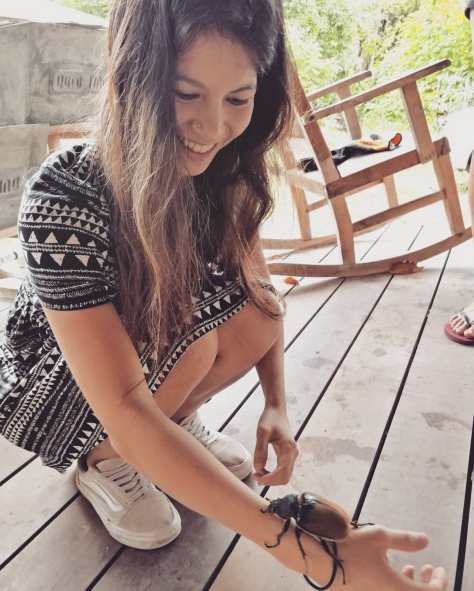
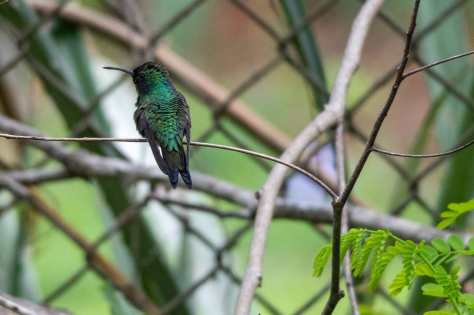
Panama has one of the highest bird biodiversities on the planet.  On a daily basis, we can see flocks of parakeets flying around our office and see different hummingbird species flutter around.  There are also many cool insects, in particular beetles! We found a giant female Elephant beetle (scarab) on the road near the office and rescued it so it wouldn’t get run over by a car.

There were also many iguanas in Panama.  Also, off the coast of Pedasi there is an island called Isla Iguana! There you can even find black iguanas!
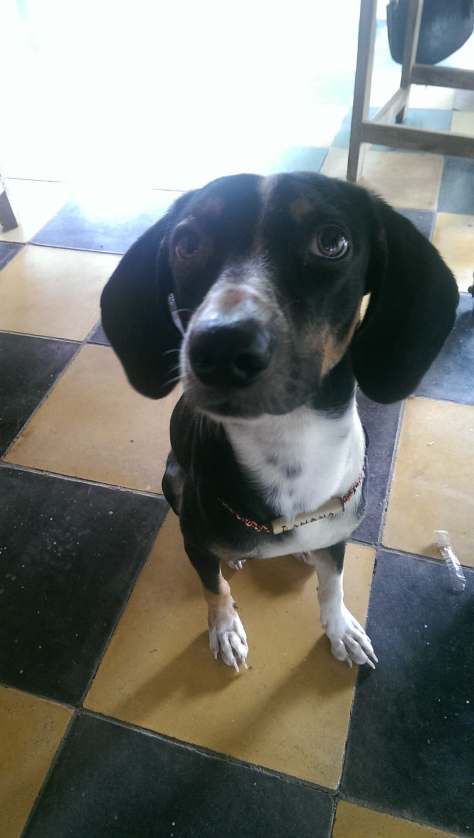
Last but not least, take care of street dogs that follow me home.

Banane is young dog who started hanging out at the Pro Earth Azuero office a couple of weeks before I arrived.  He’s super sweet and he walked us home every night. We slowly found out that he used to be owned by a local bakery but his owners thought he had died after he ran away, he was known as Collarito then because of the white collar pattern around his neck. Apparently he was later hit by a car and someone took him to the vet and took care of him. Then he crashed at the local artist’s house for 3 weeks and was named Loki. Now he decided that the office is his home and the volunteers and interns have been taking care of him!
 

Mental funeral for one?

Excited. Lost. Determined. Three emotions most of us can probably relate to right now.

The result of Googling “lost” and hoping for images that will accurately reflect your mixed emotions but instead all you get are 2,830,000,000 hits on a TV series you never watched.

I’m not one who normally feels compelled to publicly share the chaotic tangled mess of a yarn ball that my brain feels like (hence why I got rid of my Facebook), but maybe some of you can relate to the deeply personal expulsion of word vomit–for lack of a better term, and yes that’s a Mean Girls reference–that is about to ensue.

It’s not often that I feel extremely lost in life. Quitting my job with the Ape Cognition and Conservation Initiative was one of those times, but I knew I would be alright because I would find some menial job while aggressively pursuing grad school or hopping on some African elephant research project. I pushed myself to contact organizations and people in Africa that might accept me as a research assistant, landed on a couple of offers, but was ultimately convinced that a higher education would benefit me and subsequently others the most in the long run.

A telescope pointed at a wall

But now? Completely lost. It’s like I have a telescope that’s been focused on the stars for so long and now that I feel like I’ve finally reached them, it’s been redirected and pointed at a wall. A freaking wall. Not even a nice mural or something with texture. Just a gray-ass wall. I have been working towards this goal of “Get a Masters, go to Africa, save the elephants,” for 15 years and now it’s finally happened and it’s almost over. What the H*CK. Now what?! NOW WHAT, UNIVERSE. Where do I point the telescope now? “Wherever you want, Liz!” And where exactly is that…? I’m just asking, I’m not saying “I can’t answer that” and feeding into negative self-talk, but if I could get a little bit of a hint, that’d be great. I’ll wait. But just know, Universe, that while I’m waiting heavy-breathing and impatient racing thoughts that make my back seize up will be taking over so if you could hurry the f$#% up, that would also be great.

I’ve been filling my free time with self-help books and positive affirmations (even if they are weakly mumbled through tears) that “everything will work out,” (whatever that means). I’m ready to manifest the awesomeness that lies before me and you should be ready too.

Should I take the job?

I’ve applied to over 24 jobs and have received an offer from only one which. I. Declined.

“But Liz, why would you apply if you weren’t going to accept it if they offered?”

Because I’m desperate.

“Apparently not that desperate.”

No, I am. Trust me.

*cue the $93k student loan debt orchestra warming up to the JAWS theme song but instead of a shark, it’s a whole lotta money, and at this point, you’d prefer dealing with a shark over having to pay the government back. In fact, you’re actively rooting for said shark-daydream to absolve you from those stupid loans you signed up for at the astute age of 17.

Me.

“So why didn’t you take the $15/hour, seasonal position of working for Applied Ecological Services as a Restoration Field Crew Member in Illinois? “

Because I think I’m starting to stumble upon my worth…Can that be my excuse for not accepting it? Does my higher-self know that something better is just around the corner, or did I just make a mistake? Who knows. Nobody knows. But I declined.

Did I mention my paper and deliverables are in no way completed even though they’re due tomorrow? Who is this procrastinator I’ve become? Where is this mental and creative block coming from? Why is it that I can write another blog post that’s not even required but focusing on all these big projects I’ve known about for months seems near impossible?

Perhaps it’s because if I focus on wrapping up these assignments, I’ll be forced to acknowledge that this goal has been reached and this chapter of my life is therefore permanently and irrevocably over.

Yikes.

Dearly beloved, we are gathered here today

Okay, maybe that headline is a bit dramatic. But I need to remember that just because one dream has been fulfilled (and good Lord was it a big one) doesn’t mean I can’t fulfill others…right?

Yet it feels like I’m attending a funeral held inside my head; wearing all black, standing in the rain like a grieving widow as the casket slowly lowers my precious little baby goal into the dark unknown, while I cry out, “Why? Why did you have to go? What am I supposed to do without you?”

Sorry, bereaved Liz. Time to bury it and move on. Figure it out. Create another goal. Accept this as a transition in your life and just move with it. Keep pursuing whatever interests you because you’ll attend numerous mental funerals in your lifetime, but they’ll never overshadow all of your celebrations.

To anyone else in the cohort who may be feeling the same way, I encourage and challenge you (and me) to flip your thinking and view this as an accomplishment and a beginning. It’s not the end of my story or any of ours, it truly is just the beginning. Bring on the next chapter and let’s make it filled with adventure!